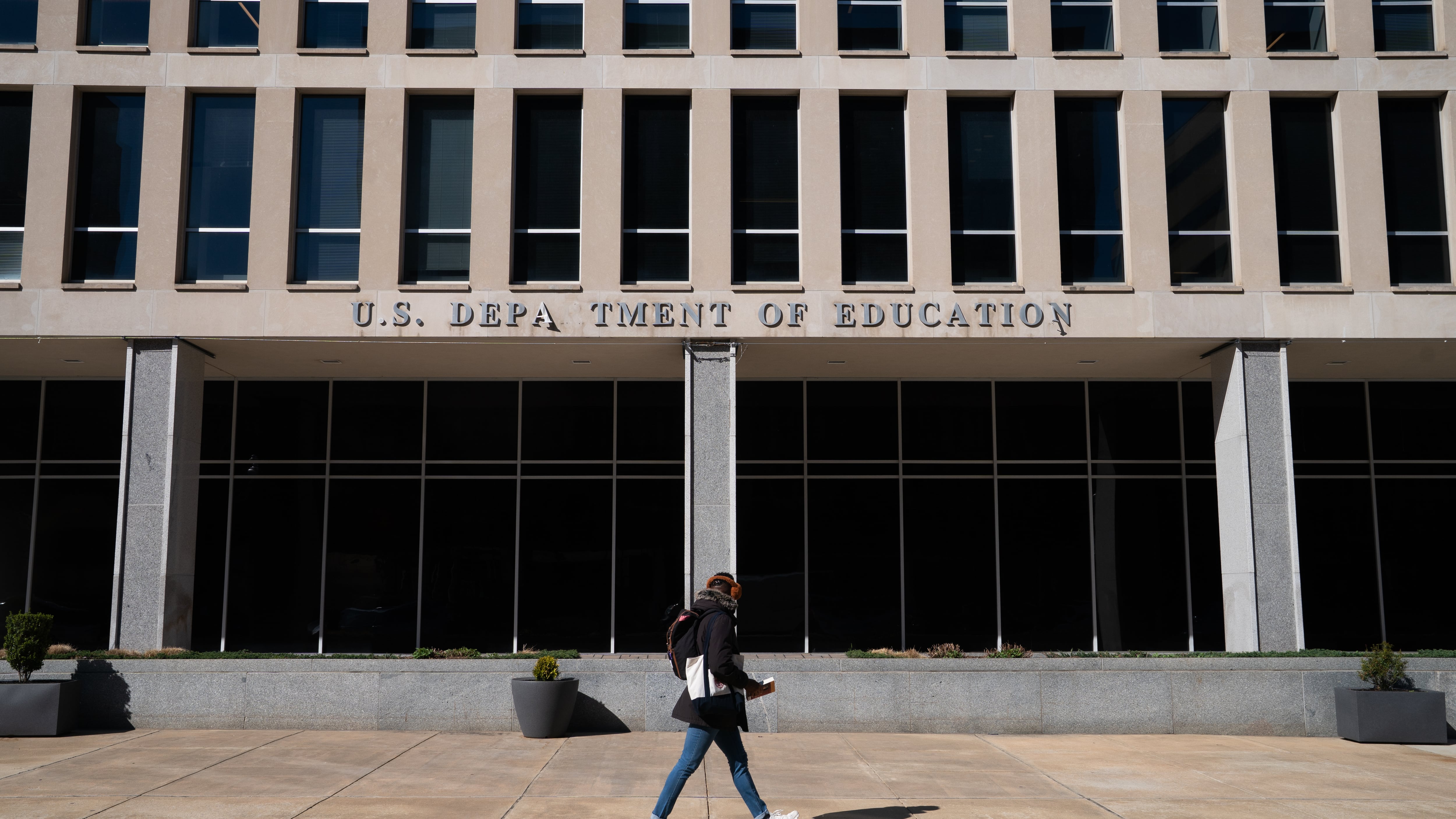
WASHINGTON — Democrats in Congress are preparing to flex their soon-to-be majorities in opposition to some of President Donald Trump's marquee education policies, starting with the dismantling of the U.S. Education Department. But with Trump threatening to use his veto power, they may be limited to opening investigations and using federal funding as leverage.
The White House has given no sign of backing away from its campaigns to close the department and to end diversity, equity and inclusion policies. But Democrats are preparing to use their oversight and appropriations powers to push back against Trump administration decisions that have reverberated through schools and universities.
Rep. Bobby Scott of Virginia, the top Democrat on the House Committee on Education and the Workforce, said he plans to “leave no rock unturned” as he takes the helm of the panel's investigative powers, which include authority to issue subpoenas and hold hearings.
The committee is preparing to explore the Trump administration's dismantling of the Education Department, its oversight of federal student loans and its anti-discrimination policies, Scott said. Under Trump, the Education Department has prioritized investigations into transgender issues while backing away from addressing systemic racism in schools.
A day after the midterm elections, Scott sent a letter to 10 federal agencies reminding them to preserve records that might become part of a congressional review.
Sen. Elizabeth Warren, a Massachusetts Democrat, called on Democrats to “hold the Trump administration accountable for dismantling the Department of Education and turning its back on students.”
Trump officials denounced Democrats' plans, with Education Department spokesperson Savannah Newhouse saying they're plotting to "prematurely sabotage" Education Secretary Linda McMahon. White House spokesperson Liz Huston accused Democrats of failing American students with "disastrous leadership" before Trump returned to office.
Investigations aren't likely to stop Trump agenda
Congressional investigations can be used to apply political pressure and uncover how decisions were made, but they are unlikely to present a substantial brake on Trump's education policies that have outraged Democrats over the last two years. And with Trump pledging to veto Democratic bills he sees as harmful, there's little optimism for legislative countermeasures.
“We’re very happy that this Congress is unlikely to pass legislation like the legislation that was passed last year," said Diana Autin, executive director of the SPAN Parent Advocacy Network, a nonprofit based in Newark, New Jersey.
Still, she said, "it’s not very likely that they will be able to undo the harm that’s already been done.”
Democrats on the Senate Appropriations Committee are exploring harder checks through the budgeting process. Some are planning to add conditions to spending bills aimed at reining in the Trump administration's education agenda.
“I think there will be an interest in using the power of the purse to establish guard rails and prevent these abusive practices,” Sen. Chris Van Hollen, a Maryland Democrat on the Appropriations Committee, told The Associated Press.
Last year, Democrats failed to secure broad language in a funding bill to block further dismantling of the Education Department. Now, with majorities in both chambers, they're preparing to try again. Van Hollen described it as one avenue to “stop the bleeding” but not necessarily to reverse the dismantling that has been done.
“It’s a little harder to try to rebuild an entity just through an appropriations bill,” he said. “But we can certainly try to prevent further damage and then seek to reverse the harm that’s been done.”
There's also interest in conditioning federal funding to rein in Trump's battle to reshape higher education, Van Hollen said, including the White House's repeated efforts to cut funding at Harvard and other prestigious universities. "That said," he added, "we're dealing with an administration that has demonstrated no respect for the law."
Education advocates are pushing Democrats to go a step further. Some hope to see appropriations language ordering the administration to reverse decisions moving Education Department functions to other agencies, including one that put special education programs under the Department of Health and Human Services, and another that put the investigation of school discrimination claims under the Justice Department.
“I think it’s going to become more and more apparent that they don’t have the authority just to keep dismantling some of these offices,” said Aaron Ament, president of the advocacy group Student Defense, which is representing plaintiffs in a lawsuit challenging the dismantling of the Education Department.
Some want Democrats to pass bills, despite veto threat
Some advocates are hoping the next Congress will be in place in time to approve the nomination of a replacement for Harmeet Dhillon, an assistant attorney general who spearheaded the Justice Department's sweeping investigations into elite universities. She announced her resignation last Thursday in the wake of the midterms. Alarming to some education advocates, however, is Trump's decision promoting Stephen Miller, the architect of some of Trump's most hard-line policies, to chief of staff.
Todd Wolfson, president of the American Association of University Professors, said that the higher education environment was so tough that the organization endorsed candidates for the first time during the midterms. Those candidates included Abdul El-Sayed, a former professor, who won a bitter campaign for Michigan's open Senate seat. Now, Wolfson is looking not just at reversing some of what has happened during the Trump administration, but building a campaign for a free public higher education system.
“Most other countries have figured this out, and we can too,” Wolfson said.
But with Trump's veto power, such a change is unlikely in the next two years.
Trump's second term in office has been marked by seismic change in education policy. Trump officials cut the Education Department's staff by nearly half and signed intergovernmental agreements parceling its top duties to other agencies. In higher education, the administration has mounted a battle to eliminate DEI practices and curb international enrollment, using federal funding as leverage to advance policies favored by the White House.
Yet education issues receded to the background in midterm elections that became a referendum on Trump's deeply unpopular economic policies and the Iran war. As Democrats sort out a vast oversight agenda, education is expected to fall farther down the list of priorities, behind big topics like Trump's self-enrichment and federal immigration raids.
Despite their new power, there's little optimism that Democrats will be able to override Trump's veto on big education bills. Some advocates want lawmakers to try anyway.
“Even if he vetoes them, let’s put the pressure on to get it to his desk, and then you see what the contrast is,” said Randi Weingarten, president of the American Federation of Teachers union.
Some on the right are pushing for last-minute legislation to advance Trump's agenda. A day after the midterms, the Heritage Foundation asked Republican lawmakers to propose a bill to close the Education Department and strip any mention of it from federal law. In what amounts to a political Hail Mary, the group argued the agency has failed to prove its value since it opened in 1980.
The letter asked Republicans to collaborate with McMahon “to sunset this failed bureaucracy.”
___
Hollingsworth reported from Mission, Kansas.
___
The Associated Press' education coverage receives financial support from multiple private foundations. AP is solely responsible for all content. Find AP's standards for working with philanthropies, a list of supporters and funded coverage areas at AP.org.
Copyright 2026 The Associated Press. All rights reserved. This material may not be published, broadcast, rewritten or redistributed without permission.