PHOTOS: Coast Guard cutter returns to Seattle after 133-day deployment monitoring Chinese vessels in Arctic
Image 0 of 8
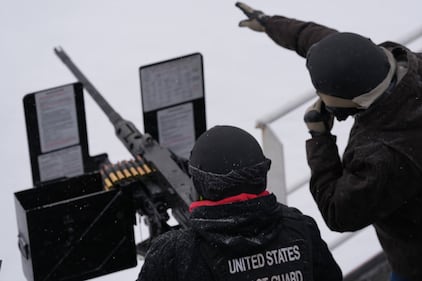
Coast Guard cutter returns to Seattle after 133-day deployment monitoring Chinese vessels in Arctic USCGC Storis (WAGB 21) crew members Petty Officer 1st Class Alex Fernandez, left, and Ensign Joshua Dees, right, conduct a live-fire gunnery exercise while operating in the Arctic Ocean, Sept. 18, 2026. This was the first live-fire gunnery exercise by a Coast Guard surface asset in the Arctic region in decades. (U.S. Coast Guard photo by Ensign Maddox Holmes-Selby) (U.S. Coast Guard Pacific Area)
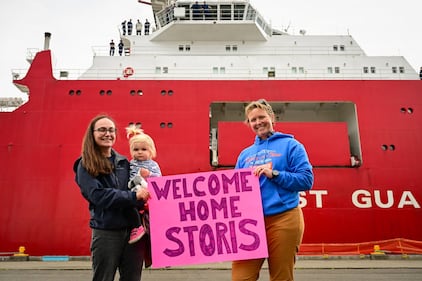
Coast Guard cutter returns to Seattle after 133-day deployment monitoring Chinese vessels in Arctic A mom and son wait on the pier at Coast Guard Base Seattle and hold a sign as USCGC Storis (WAGB 21) returns to its temporary homeport of Seattle on Nov. 14, 2026. The crew of the Storis traveled more than 17,000 nautical miles during their 133-day deployment to the High Arctic. (U.S. Coast Guard photo by Petty Officer 1st Class Steve Strohmaier) (Petty Officer 1st Class Steven S Petty Officer 1st Class Steven Strohmaier/U.S. Coast Guard Pacific Area)
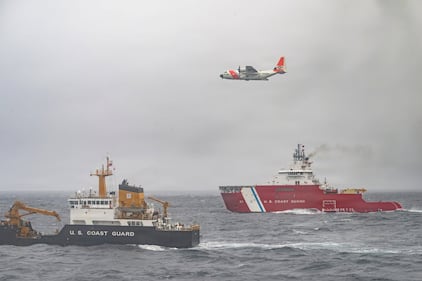
Coast Guard cutter returns to Seattle after 133-day deployment monitoring Chinese vessels in Arctic U.S. Coast Guard Cutter Fir (WLB 213) and Storis (WAGB 21) sail alongside each other as a USCG HC-130 Hercules aircraft soars overhead during a combined sail in support of Operation TUNDRA MERLIN, as viewed from the Royal Canadian Navy vessel HMCS Max Bernays (AOPV 432) in the Bering Sea, July 21, 2026. Operating under the framework of OTM, the combined sail successfully enhanced multi-domain awareness from the sea to space across the Alaskan Theater of Operations. These joint maneuvers allowed participatin (Staff Sgt. Christopher Chen/Alaskan NORAD Region/Alaskan Com)
Coast Guard cutter returns to Seattle after 133-day deployment monitoring Chinese vessels in Arctic Coast Guard Cutter Storis (WAGB 21) transits through the Bering Sea during a combined sail supporting Operation Tundra Merlin, July 21, 2026. The oepration brought the USCGC Munro (WMSL 755), Storis (WAGB 21), and Fir (WLB 213) together with the Royal Canadian Navy vessel HMCS Max Bernays (AOPV 432) to strengthen inoperability and reinforce the enduring maritime partnership between the United States and Canada. Operating under the framework of OTM, the combined sail successfully enhanced multi-domain awaren (Petty Officer 3rd Class Cameron Petty Officer 3rd Class Cameron Snell/U.S. Coast Guard Arctic)
Coast Guard cutter returns to Seattle after 133-day deployment monitoring Chinese vessels in Arctic USCGC Storis conducts icebreaking operations in the Arctic Ocean during the cutter’s 133‑day deployment to the region, July 28, 2026. As the Coast Guard’s newest icebreaker, Storis enforced maritime safety, security, border control and national sovereignty as the sole U.S. surface asset deployed to the High Arctic. (U.S. Coast Guard courtesy photo) (U.S. Coast Guard Pacific Area)
Coast Guard cutter returns to Seattle after 133-day deployment monitoring Chinese vessels in Arctic From left, U.S. Coast Guard Cutter Fir (WLB 213), Storis (WAGB 21), and Munro (WMSL 755) sail alongside each other during a combined sail in support of Operation Tundra Merlin in the Bering Sea, July 21, 2026. Conducted in coordination with the Canadian-led Operation Latitude and the U.S. Coast Guard-led operation Frontier Sentinel, the combined transit demonstrated seamless binational defense in the Arctic. This collaborative effort under Operations Tundra Merlin strengthened tactical integration and valid (Petty Officer 3rd Class Cameron Petty Officer 3rd Class Cameron Snell/U.S. Coast Guard Arctic)
Coast Guard cutter returns to Seattle after 133-day deployment monitoring Chinese vessels in Arctic Family members hold a sign and wait on the pier at Coast Guard Base Seattle as USCGC Storis (WAGB 21) returns to its temporary homeport in Seattle on Nov. 14, 2026. As part of Operation Frontier Sentinel, the crew of the Storis spent more than 300 hours monitoring foreign‑flagged research vessels across the Arctic and worked with other U.S. Coast Guard and Royal Canadian Navy units while transiting the High Arctic. (U.S. Coast Guard photo by Petty Officer 1st Class Steve Strohmaier) (Petty Officer 1st Class Steven S Petty Officer 1st Class Steven Strohmaier/U.S. Coast Guard Pacific Area)